If we look at the physical differences between western and mountain gorillas, we should not be surprised that they have very different lifestyles. The way they live in their natural habitat, their ecology, is determined by their environment. Mountain gorillas adapted to volcanic peaks as their lowland forests disappeared. Here the vegetation is poor quality and predominantly herbs such as nettles, thistles and celery, with few big trees and almost no succulent fruit. In the volcanoes, gorillas are folivores – they eat leaves, stems and roots. Mountain gorillas feeding on “salad” do not travel very far each day as they are surrounded by their food.
Lowland tropical forests are hot and humid, with a large diversity of trees up to 35 m (100 feet) tall or more. Dozens of types of fruit are produced by trees and shrubs which may have fruit for only a few days or a few weeks of the year. Gorillas in Gabon eat more than 140 plants, and 95 of these foods are different species of fruit. Fruit forms a large volume of the diet of Western lowland gorillas so we call them frugivores. Consequently, lowland gorillas are efficient seed dispersers and they play an important role in forest regeneration – the regrowth of forest which has been cut down. For example, during one month of each year at Lopé, 18,000 seeds of a single species are deposited in the dung of each gorilla which feeds on its fruit.
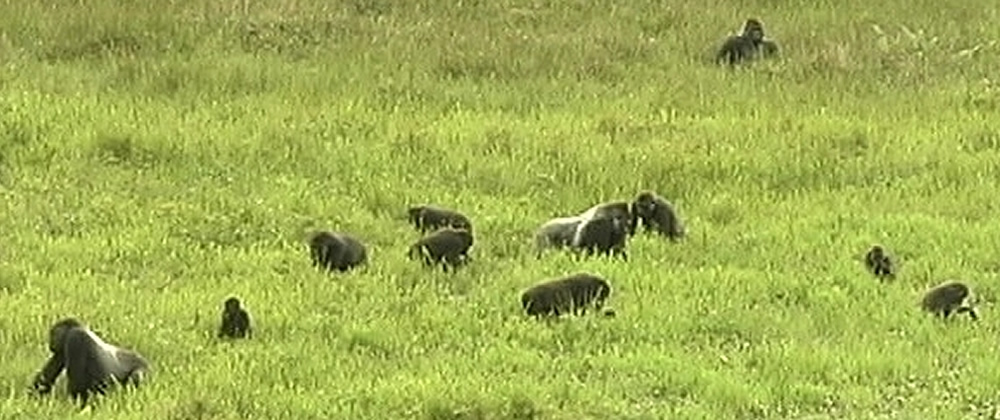
Gorillas must be agile climbers to be able to reach fruits as they become ripe, and so Western gorillas are lighter-bodied with longer, slender limbs than Mountain gorillas, who must also build up insulation against the cold; temperatures in the volcanoes drop below freezing at night. All gorillas are vegetarian, except that from time to time, they eat ants or termites when they come across a nest or mound in the forest.
Differences in feeding behaviour influence the daily ranging patterns of gorillas. The distances which lowland gorillas move in the forest each day while they are searching for food may vary between 1 km and 4 km, as they move from one fruit tree to another. In contrast, Mountain gorillas usually travel about 0.5 km each day.
The size of the home range, the area used by one group of gorillas during one year, is also in part determined by diet, thus Western lowland gorillas have large ranges of between 20 and 40 square kilometers. Mountain gorillas have home ranges of only 8 to 10 square kilometers. These ecological differences help to explain why Western lowland gorillas are difficult to track and to study.
During the past 15 years, we have learned a lot about the feeding and ranging of Western gorillas; much less is known about their social behaviour. Average group sizes are similar between east and west, however, large groups of 30 and even 40 members are unheard of in the west. Many Mountain gorilla groups have several silverbacks (from 2 to 6), whereas almost all lowland groups contain only one adult male. The size of groups is constrained by the availability if resources in their habitat, most importantly the quality and quantity of food.
Nonetheless, all gorillas are similar in that they usually live in groups with at least one adult male, several females and their offspring of various ages. Females will start to reproduce at around 9 years of age, and the spacing between births is quite lengthy 3.5 to 4 years. An infant will suckle and sleep with its mother (gorillas build nests) for the first 3 years of life, and this dependence on the mother¹s care means that during her lifetime, a female gorilla can produce 5 or 6 infants at most. Such a slow reproductive rate is an important reason why gorillas are so vulnerable. It takes many years for a population to increase in size, and many more to recover from poaching.