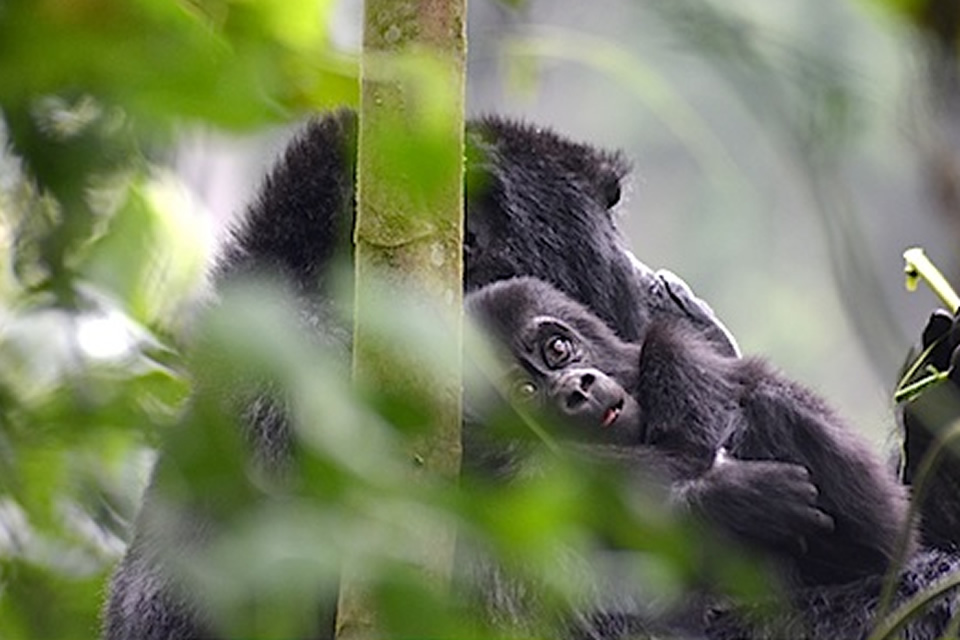
A census of mountain gorillas, Gorilla beringei beringei, conducted in 2011 in Uganda’s Bwindi Impenetrable Forest, confirms a minimum population of 400 gorillas, raising the world population of mountain gorillas to 880. The official result was released today by the Uganda Wildlife Authority.
The increase in the Bwindi population since the last census, from 302 in 2006 to 400 in 2011, is attributed to improved census techniques of these rare and elusive apes as well as real population growth.
In this latest census, teams systematically moved through Bwindi not once, but twice, looking for and documenting mountain gorilla night nests and feces, and collecting fecal samples for genetic analysis. The first sweep was conducted with a small team from February 28 to September 2, 2011 and the second sweep conducted with multiple teams from September 10 to November 3, 2011. With the genetic analysis, scientists were able to determine how many unique gro
Mountain gorillas live in only three countries: DR Congo, Rwanda, and Uganda. In 2010, a census took place in Rwandan and DR Congo National Parks along the Virunga Massif. In 2011, the results were announced at 480 mountain gorillas. When combined with the 300 mountain gorillas from Uganda’s 2006 census, the world total came to 780. Last year, a new census took place in Uganda’s Bwindi Impenetrable Forest, and the results were released today. Here is a report from the International Gorilla Conservation Programme (IGCP).
The 2011 Bwindi mountain gorilla census was conducted by the Uganda Wildlife Authority with support from l’Institut Congolais pour la Conservation de la Nature and the Rwanda Development Board. The census was also supported by the International Gorilla Conservation Programme (a coalition of the African Wildlife Foundation, Fauna & Flora International, and WWF), the Max Planck Institute for Evolutionary Anthropology, Conservation Through Public Health, the Mountain Gorilla Veterinary Project, the Institute of Tropical Forest Conservation, and the Dian Fossey Gorilla Fund International.
This census was funded by WWF-Sweden with supplemental support from Berggorilla & Regenwald Direkthilfe e.V., the Wildlife Conservation Society, and the Max Planck Institute for Evolutionary Anthropology.
Leave a Reply